

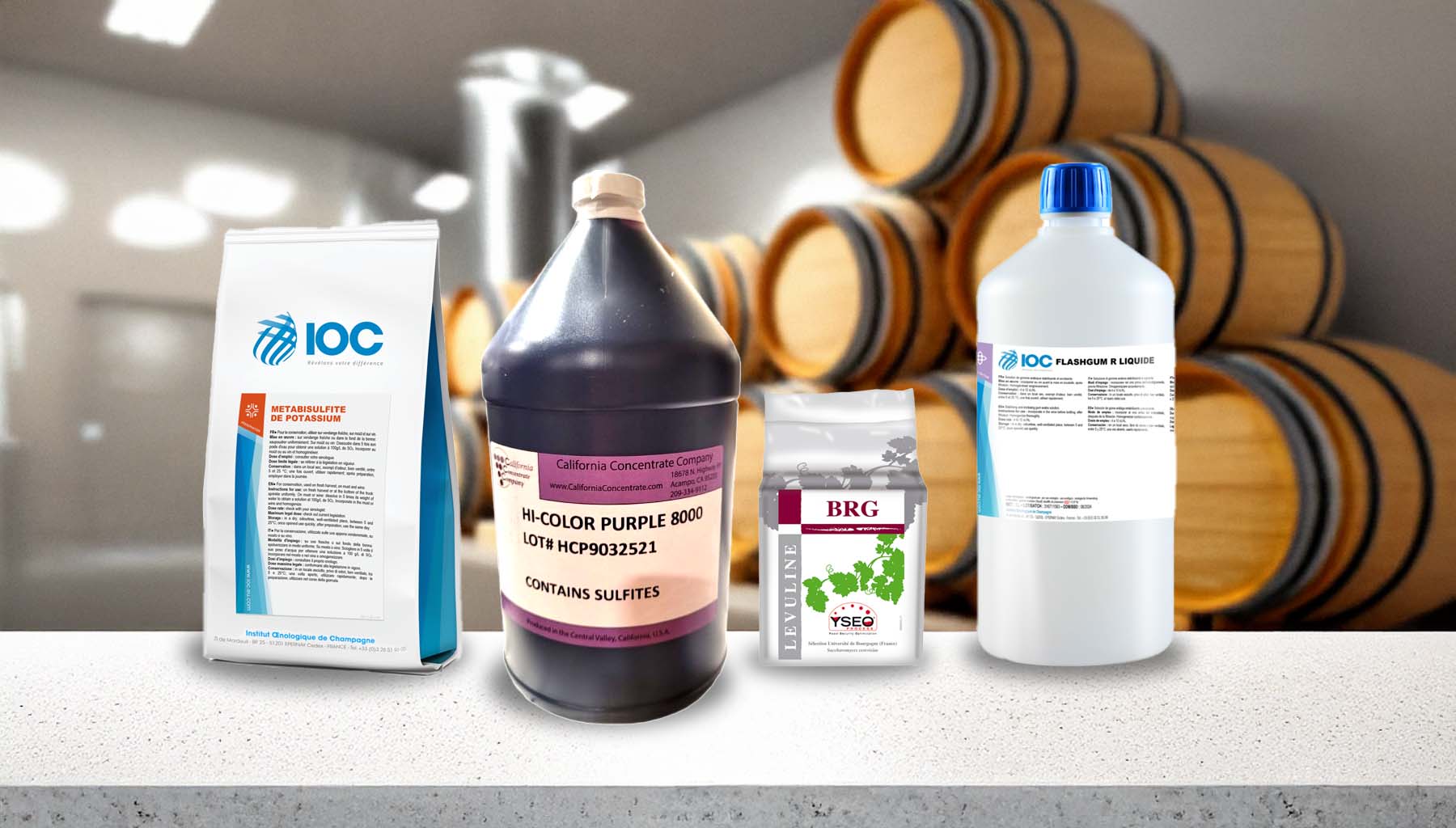
I’ve already received quite a few questions about a comment I made in my last email. No, not the admittedly too-crass Valentine’s stuff… I’m talking about the “containers full of additives and sugar” remark. I recognize that sometimes my crass sense of humor can undermine my intensely serious approach to my craft, and that this would be a good time for a serious winemaking discussion about additives and the myth of the “sulfur allergy” and the “red wine headache”.
I’d like to start with a full disclosure of my own approach to additives: with the exception of SO2, if I wouldn’t eat it when mixed with water, I won’t add it. I do use minimal effective SO2. As for other things, my wine is made of grapes, sometimes commercial yeast (derived from native fermentations in Burgundy), sometimes supplemental tartaric acid (naturally occurring already in grapes), sometimes supplemental organic nitrogen (naturally occurring in grapes) and sometimes a supplemental tannin comprised solely of powdered grape skins, oak and Quebracho (a Spanish hardwood tree). Most of the time in my wine, all that’s in it is grape juice fermented with a mix of ambient (native) & Burgundy yeasts and SO2. That’s it. This is, more often than not, very much not the case with that $10 bottle of wine you bought at the supermarket.
So let’s talk about SO2 (sulfur dioxide). Since Roman times, sulfur dioxide has been used in wine as a preservative. A small amount of it comes with the grapes themselves, and is then supplemented at various stages of the winemaking process. In Roman times, sulfur dioxide was not “mined” directly as a gas, but rather produced by burning elemental sulfur (often called “brimstone”) or roasting sulfur-rich ores. The Romans obtained the necessary raw sulfur from volcanic sources and, to a lesser extent, from mining, using it for fumigation, winemaking, and, in some cases, military applications. In wine, SO2 works as an antioxidant: it sucks oxygen out of its surroundings. Without oxygen, microbes can’t grow and wine can’t oxidize, or prematurely age.
While SO2 isn’t the only thing that can prevent microbial growth, it is one of the most effective wholly natural, organic, anti-microbial agents you can put in wine, and it’s effective at very small doses. A bottle of red wine bottled at .5 molecular SO2 is considered to be stable, and should be free of any microbial surprises like secondary fermentation or other kinds of spoilage. The amount of free SO2 in an entire bottle of red wine is roughly equivalent to the amount found in 2-4 dried apricots. A single, conventionally dried, bright orange apricot typically contains approximately 16mg of sulfur dioxide. While levels vary, commercial dried apricots are often treated with SO2 at concentrations between 1,000 and 3,000 parts per million (ppm). A relatively big bottling addition for 120 gallons of wine would be around 30-40g of SO2. That’s for 50 cases of wine. If you have often said “I can’t drink red wine because I have a reaction to SO2 and it gives me a headache”, I have news for you that will improve your life: it’s not the SO2. White wine has a higher amount of free SO2 than red wine. And if you can eat 4 dried apricots and not get a reaction… well, it’s not the SO2.
So what is it then?
Tannin is a natural antioxidant as well. It’s also a plant-based material, coming from the seeds, skins and stems of grapes and wood; as a plant-based material, it has been shown to trigger allergies in people at a rate considerably higher than SO2. The use of supplemental tannin is a common way to reduce the amount of total SO2 needed to stabilize a wine. The side effects of tannin can be flavor impact (good or bad), color impact (good or bad), dehydration (it sucks up moisture in your body) and, in some people, allergies. And many winemaking tannins (and other additives) are proprietary formulas– aka we don’t know entirely what’s in them.
Big red wines like Cabernet Sauvignon are loaded with tannins, among other things. Crafting a big, extracted Cab frequently requires supplemental soft tannin on top of the skin tannins, things like gum arabic to soften the harsh edges of the fermented wine, and then supplemental sugar to round out the mouthfeel. These wines often see significant saignée (bleeding out of juice) to concentrate the wine, and in doing so, the winemaker increases the skin-to-juice ratio. In order for the skin tannins to not be too astringent at this high skin ratio, the fruit typically needs to be extra ripe. So that means it has a high pH. With high pH you need more SO2 than usual to get to .5 molecular. If the tannins are still too harsh, supplemental soft tannin is added. Then, because the fruit was super ripe, alcoholic fermentation stops with some residual sugar remaining, because the yeast can’t survive in that hostile environment. If it doesn’t stop, often supplemental concentrate (sugar) is added, along with with fining agents like gum arabic, isinglass (fish bladders), gelatin or, in less intrusive cases, egg whites or mannoproteins (naturally occurring in grapes). If the wine is a large production job meant for supermarkets around the world, frequently fermented grape juice will have been trucked from all over the state in tanker trucks, for which it would have needed further stabilization with other anti-microbial agents before trucking and then again after addition to the massive blending tank. Now, the winemaker of record has to put his imprint on it, to match the flavor profile of that mass produced wine year-over-year, so what does he/she add additionally? Mega Purple for color? Chitosan? More gelatin? Get out the cook book, it’s around 100 pages thick and none of it has to be disclosed on the label.
This is not to say there aren’t balanced, additive-free Cabs out there. I love Cab. I’m just talking about a specific type of mass produced wine, using a specific, common production style. Nutshell: the headache isn’t from SO2 in red wine. It’s from the kind of wine and the massive additive soup that’s in it. It’s from the poor quality of a particular style of wine and how mass production at low prices impacts that quality. It’s from alcohol + dehydration + extra tannin + extra sugar + extra SO2 + extra… junk.
Before giving up on red wine because you’ve gotten a headache from it in the past, try drinking a small production, minimal intervention Pinot Noir that’s made with just grapes, yeast and SO2. Pinot Noir is lower in tannin than many other reds. In the absence of all the aforementioned junk, I’d be willing to bet that you come away feeling pretty darn good. Then, if that worked, move into a clean (relatively additive-free) bigger red and see how that works. If you can get all the way through Cabernet to Petite Sirah on additive-free wines without a headache, then you’ll know it’s not SO2 or tannin that’s the problem, but perhaps sugar or miscellaneous additives. If you get hit with issues when you get to the more tannic wines, there you go– it’s a sensitivity to tannin. And moving away from additives does not immediately equate to paying more for your wine. I know many small, honest producers of high-quality “clean” wine that doesn’t cost an arm and a leg. I think the takeaway here is this: know your winemaker.
Of course, I’m not suggesting you do all of that in one night! That would be… special…
So, in essence, I guess I’m a kind of natural winemaker of sorts… in the sense that I don’t put anything in it that wasn’t already there. Grapes, yeast and SO2. Novel concept!